Summary
Oyamazumi Shrine (大山祇神社) stands on Omishima Island in the Seto Inland Sea and is revered as the Ichinomiya (chief shrine) of Iyo Province as well as the ancestral shrine of all Oyamazumi and mountain kami shrines in Japan.
Dedicated to Oyamazumi no Okami, a deity of mountains, the sea, and safe travel, it has long served as a protective sanctuary for seafarers navigating the Seto Inland Sea and for travelers crossing the region.
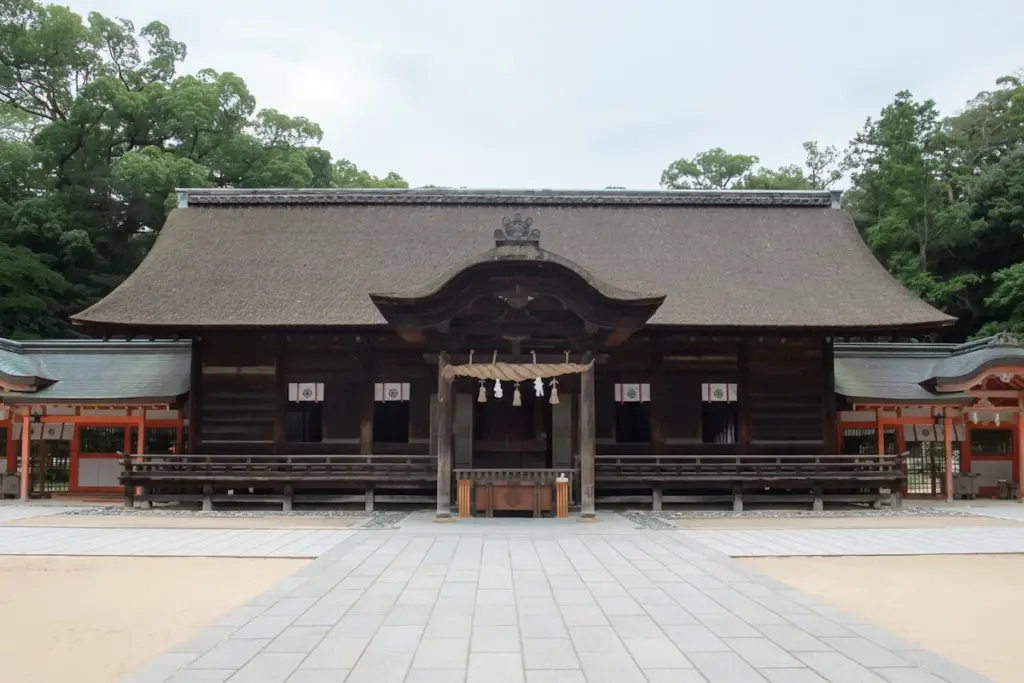
Photo by Mika-wa-Taro, CC BY-SA 3.0.
Key Facts
- Province: Iyo (historical province); widely regarded as the Ichinomiya (chief shrine) of Iyo.
- Enshrined Deities: Oyamazumi no Okami (大山積大神), revered as a kami of mountains, sea, and safe travel. Together with the auxiliary shrines of Kamitsusha and Shimotsusha, the three form the full Oyamazumi Shrine complex.
- Founded / Legend: Shrine tradition says that Ochi no Mikoto, a descendant of Oyamazumi no Okami who came to Shikoku before Emperor Jimmu’s eastern expedition, enshrined the deity on Omishima.
- Architecture: The main honden (本殿) is a three-bay nagare-zukuri structure from the early Muromachi period, with cypress bark roof and vermilion and white plaster; the haiden and auxiliary shrines also date to the same era. Several buildings are Important Cultural Properties of Japan.
- Setting: Located at the foot of sacred mountains and close to the shore of the Seto Inland Sea, along the modern Shimanami Kaido route.
History in Brief
According to shrine legend, Oyamazumi no Okami is a mountain and sea kami who protects land, forests, and travelers over water. Ochi no Mikoto, a descendant of the deity, is said to have brought this worship to Omishima before the legendary eastern campaign of Emperor Jimmu. The island later became an important guardian point for ships crossing the Seto Inland Sea.
Historically, Oyamazumi Shrine received strong devotion from local warrior clans such as the Ochi and Kono families. Many samurai offered armor and swords in thanks for victories and safe return. The present honden and haiden date from the early Muromachi period and are Important Cultural Properties. The three mountains behind the sanctuary are remembered as ancient shintai-zan (sacred mountains).
Enshrined Deities
The main kami of Oyamazumi Shrine is Oyamazumi no Okami, described in ancient records as a kami of mountains and also linked with the wide ocean and seafaring. In shrine tradition, this deity is the father of Konohanasakuyahime, who became the consort of Ninigi no Mikoto; for this reason Oyamazumi is also respected as an important ancestral kami for the imperial line.
Many visitors pray here for safety in travel, protection in the mountains and at sea, strength in life, and the well-being of their families. The auxiliary shrines of Kamitsusha and Shimotsusha enshrine related thunder and water deities, emphasizing the close link between mountains, rain, and abundant harvests.
Etiquette
Please keep these simple manners in mind when visiting the shrine.
- Purify your hands and mouth at the temizuya (手水舎).
- Bow twice, clap twice, and bow once (ni-rei ni-hakushu ichi-rei).
- Keep quiet around the honden (本殿, main sanctuary).
- Please refrain from eating, drinking, and smoking within the shrine grounds.
- Aerial drones are strictly prohibited.
- Please be mindful when taking photos, as some areas may be sacred.
Visitor Tips

- Do not miss the sacred camphor tree in front of the main worship hall (haiden), said by tradition to have been planted by Ochi no Mikoto. It is over 2,600 years old and is one of the most powerful symbols of the shrine.
- Take time to visit not only the main hall but also Kamitsusha and Shimotsusha, the auxiliary shrines that complete the Oyamazumi Shrine complex.
- The shrine grounds are mostly flat, but comfortable walking shoes are recommended for exploring the precincts and nearby areas on Omishima Island.
- If you are interested in samurai culture, plan extra time to visit the shrine’s treasure museums (see below) located within the grounds.
Photography may be restricted near sacred areas. Please follow on-site signs.
Omamori (Amulets)
Common omamori (お守り) for general good fortune are typically available, along with charms for traffic safety and success in challenges. Offerings are made as hatsuhoryo (初穂料). Shrine offices usually accept cash only.
Treasures & Museum
Oyamazumi Shrine is famous for its large collection of samurai arms and armor. Many items are National Treasures and Important Cultural Properties, including ancient armor and swords linked to historic warrior families.
The museum complex includes two treasure halls and a maritime museum displaying Hayama-maru, the research boat used by Emperor Showa.
Admission: Adults ¥1,000 / Students ¥800 / Children ¥400
Hours: 9:00–15:30 (last entry)
Hours and admission may change. Please check the latest information on site.
Festivals
Oyamazumi Shrine holds many rituals through the year. The three below are especially well known on Omishima Island.
- Otaue-sai (御田植祭): Early summer — a rice-planting ritual in the sacred field, followed by the unique hitori-zumo (one-person sumo) performance.
- Ubusuna Taisai (産須奈大祭): Early autumn — the main autumn festival with lively lion dances and portable shrine processions around the island.
- Nukihosai (抜穂祭): Autumn — the first rice ears are cut and offered to the kami, with another hitori-zumo performance.
How to Visit & Access
Oyamazumi Shrine stands on Omishima Island in Imabari City, Ehime, roughly in the middle of the Shimanami Kaido route across the Seto Inland Sea.
From JR Imabari Station, take a highway or express bus toward Omishima and get off at Oyamazumi Shrine-mae or Omishima bus stop, then walk to the shrine. From JR Fukuyama Station, take the Shimanami highway bus to Omishima and transfer to a local bus toward Oyamazumi Shrine. Travel time is about 60–90 minutes depending on connections.
- Address: 3327 Miyaura, Omishima-cho, Imabari, Ehime (Google Maps) ↗
- Nearest Stop: Oyamazumi Shrine-mae bus stop (or Miyaura port area) — a short walk to the shrine.
- Hours: Shrine grounds from around sunrise to 17:00. Shrine office 9:00–17:00; treasure museums 9:00–15:30 (last entry).
- Official Site: Oyamazumi Shrine (Japanese) ↗
Travel times are approximate and may vary by schedule. Hours and admission may change by season and events.
Nearby
- Murakami Kaizoku Museum: A museum introducing the history of the Murakami pirates, with some English displays and scenic views over the Seto Inland Sea.
- Tatara Shimanami Park (Roadside Station): A well-known stop along the Shimanami Kaido, popular with cyclists for views of the Tatara Bridge and local Setouchi food.
- Omishima Museum of Art & Coastline: A quiet art museum on Omishima Island, with nearby coastal spots ideal for relaxed walks and island scenery.
Support this Guide
Your support helps me continue writing and sharing shrine culture. Thank you for helping this project grow.